Showing posts with label obedience. Show all posts

Wednesday, January 28, 2009

Lessons from Practical Living, Class One

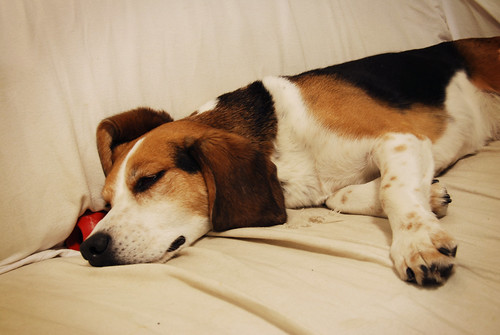
pooped out!

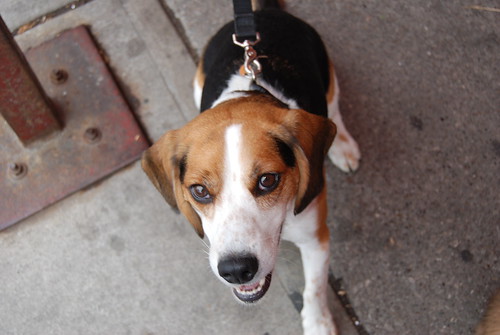
After a year hiatus, Duke's back at school! Today was his first day for the Practical Living class at Who's Walking Who, Toronto campus.

The actual class content is a good refresher for Duke, and will be good finishing work, but the main reason why we're there is to expose Duke to as many dogs as possible in a difficult environment to help with his on-leash aggression.

This class is extremely challenging for that aspect, because it is a full house (10+ dogs) in the class prior, and a full house itself (10+ dogs in our class) meaning that Duke has to manage himself in a small room where 20 dogs will go by him at some point in the night. We did not go without some howling - but he only howls when dogs start getting very close. By the end of the 6 week program Duke should be able to sniff and greet many of the dogs in class.

The agenda for tonight:

1) Loose leash walking
2) Heel - with an auto-sit. A good tip we were reminded of was to guide Duke's face away from us for the finish for a nice straight sit (not a lazy 45 degree sit, like we've been tolerating - n.b. he had this problem in Sept 2007 too at Step Ahead, but shame on us for not tightening it up)
3) Sit, stay, and pat on the head, and return
4) Sit, stay, circle Duke, and return
5) Dog bowl manners - place a bowl of food on the floor and expect an auto-sit stay (easy)

All the instructors in class know about Duke's behavioral problem so they were very helpful. We were reminded of some very important points:

1) Reward for the absence of inappropriate behavior. For example, Duke in a down stay while we're listening to the instructor tends to whine. This is actually a behavior he's always had and has nothing to do with on leash aggression. We should wait for a pause in his whining, and mark and praise the quiet. Gradually we would only reward for lengthy periods of quiet.

Applying this principle to on-leash aggression - we should mark and reward for a variety of behaviors, such as sniffing, or avoidance, in the presence of other dogs - not just a watch behavior. If Duke ever makes contact with a dog on leash we MUST mark and reward for that - it is too big of a breakthrough to let go unnoticed.

2) Rewards must always follow markers. For example, in the case of the sit command, we no longer mark and reward for all sits - but IF we choose to mark (YES or click) then we MUST reward. Random reinforcement means the random application of a mark AND reward, not the random application of the reward.

3) A suggestion is we should practice the approach and touching on leash of another dog by getting dog friends to help out. These exercises are well covered in Click to Calm by Emma Parsons and Aggression in Dogs by Brenda Aloff. I need to get serious about getting friends to help out here.


Duke's little brain must be very tired! He aced the obedience exercises but the real challenges lie ahead... like "Meet and Greet" another dog on leash. Duke, you can do it!!!!

Monday, January 5, 2009

On Leash Aggression with Beagles, Part 2

Just a quick post here. I found this great blog site by the owner of an Italian Greyhound named Peyton. He has made great progress with Peyton and has a video clip showing two very important techniques that we also use for Duke. If we end up getting cornered (dog on the left, right, front, and back) and there's no escape, this is what we do.


The two exercises being demonstrated are the Back Away and Emergency Hold.

Why are these exercises so important? It is very important to set your dog up for success and prevent him from acting inappropriately around other dogs. Each time he lashes out, you are making his problem worse by reinforcing the behavior. Its just like water - over time, water can etch into stone. Each time you put your dog in a situation where he reacts inappropriately, you've etched that behavior deeper into his psyche.

Peyton's blog can be found here for more reading:

http://igtraining.blogspot.com/2007/09/leash-aggression.html

Tuesday, December 30, 2008

Canine Good Citizen (CGC) Program


One more sleep and two exciting things will be happening:

  • 2009 is just around the corner
  • Elmo will be going on a trial adoption with a very loving and mature family. (A mom, dad, and 8 year old son)

One of my regrets about fostering Elmo is that I haven't given Duke the attention that he deserves. He's sort of reached a plateau in his training and I'm going to use the new year and Elmo's adoption as a catalyst for reinvigorating my efforts.

My aspiration and goal is to have Duke be able to (or be ready to) earn his Canine Good Citizen certification. (CGC)

What is the CGC? (taken from Wikipedia):

The Canine Good Citizen (CGC) program, established in 1989, is an American Kennel Club program to promote responsible dog ownership and to encourage the training of well-mannered dogs. A dog and handler team must take a short behavioral evaluation of less than half an hour; dogs who pass the evaluation earn the Canine Good Citizen certificate, which many people represent after the dog's name, abbreviating it as CGC; for example, "Fido, CGC".

There are ten objectives that a CGC must pass. I am happy to say Duke could pass 9 of the 10 tomorrow if he had to take the test:

  • Accepting a friendly stranger.
  • Sitting politely for petting.
  • Allowing basic grooming procedures.
  • Walking on a loose lead.
  • Walking through a crowd.
  • Sitting and lying down on command and staying in place.
  • Coming when called.
  • Reacting appropriately to another dog.
  • Reacting appropriately to distractions.
  • Calmly enduring supervised separation from the owner.
Unfortunately, he doesn't react appropriately to another dog. More specifically, the CGC requires Duke to be able to approach another handler and dog on leash, sit, and politely wait while I engage in conversation with the other handler, then depart.

In 2008, Hyedie and I worked diligently on making Duke practice avoidance around other dogs - that is, his automatic response to seeing a dog while on leash is to look at his handler and move away from the other dog. In 2009, I would like Duke to have the ability to greet another dog, touch him, and move away, all while on leash.

I've ordered a set of reference materials and training guides which I will review and keep everyone up to date on our progress over the next year!

Wednesday, September 19, 2007

Lessons from "Step Ahead" Level 2 Obedience Class - Class #5


Second last class last week, before today's fun games night. Last class Andre took the reigns and trained with Duke.

Reviewed:
  • down at a distance (remember to reward in the 'down' position

  • doggy push-ups (then progressed to push-ups with dog to the left)

  • stand stay (then progressed with instructor coming by to distract the dogs by walking by, bouncing a ball and something totally irresistible to Duke, a squeeky toy)

A new exercise that Duke failed at was doing 'sit/stays' with having every other dog stay, while the other dogs completed their 'come' command. Unfortunately Duke released from his stay every time the other handlers called 'come' to their dogs, even though it wasn't Duke's turn to 'come'. Amazingly half the dogs were able to maintain their stays even though dogs next to them ran towards their owners.

Next the owners and dogs did a heeling exercise where 'watch', 'touch', 'down', 'turns' and 'stand' were commanded while walking.

The last exercise of the night was Rally Obedience. Where 2 sets of 3 pylons were set up with 2-3 commands. For example: Sit-down-walk around, Sit-stand, sit-down. The object is to go to each pylon station and try to get your dog to complete the set of commands as fast as possible.

Rally Obedience is apparently an up and coming dog sport. Treats as rewards can be used during competition but treats can not be used as lures.

Again tonight, Duke's attention and concentration levels weren't great and he was easily distracted.

After this course, it's time to work on everything we've learned so that he can do them as fast as he can sit or go down.

Wednesday, August 22, 2007

Dogs can read your mind so be positive!

Our veterinarian and animal communicator believe that dogs are able to read your mind. So, if you are trying to train your beagle or correct your beagle's behavior (ours has a habit of howling at other dogs on the street while on leash), it is very important to have a positive state of mind. If you get into a situation where you think your dog will misbehave, there's a good chance he will!

In our case, when we are walking Duke and see a dog approaching, if we freeze up and get nervous, Duke tends to react. Recently I created a phrase that I say to myself whenever I find myself in that situation - it reads,

"Duke, here's a chance for you to really impress us!"

I find that saying that to myself puts me in a positive state of mind and I am confident that Duke can read our minds!