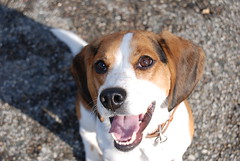
Just a quick post here. I found this great blog site by the owner of an Italian Greyhound named Peyton. He has made great progress with Peyton and has a video clip showing two very important techniques that we also use for Duke. If we end up getting cornered (dog on the left, right, front, and back) and there's no escape, this is what we do.
The two exercises being demonstrated are the Back Away and Emergency Hold.
Why are these exercises so important? It is very important to set your dog up for success and prevent him from acting inappropriately around other dogs. Each time he lashes out, you are making his problem worse by reinforcing the behavior. Its just like water - over time, water can etch into stone. Each time you put your dog in a situation where he reacts inappropriately, you've etched that behavior deeper into his psyche.
Peyton's blog can be found here for more reading:
http://igtraining.blogspot.com/2007/09/leash-aggression.html
Monday, January 5, 2009
On Leash Aggression with Beagles, Part 2
Labels:
aggression,
beagle,
dog behavior,
dog behaviour,
dog obedience,
obedience
Tuesday, December 30, 2008
Canine Good Citizen (CGC) Program

One more sleep and two exciting things will be happening:
- 2009 is just around the corner
- Elmo will be going on a trial adoption with a very loving and mature family. (A mom, dad, and 8 year old son)
One of my regrets about fostering Elmo is that I haven't given Duke the attention that he deserves. He's sort of reached a plateau in his training and I'm going to use the new year and Elmo's adoption as a catalyst for reinvigorating my efforts.
My aspiration and goal is to have Duke be able to (or be ready to) earn his Canine Good Citizen certification. (CGC)
What is the CGC? (taken from Wikipedia):
The Canine Good Citizen (CGC) program, established in 1989, is an American Kennel Club program to promote responsible dog ownership and to encourage the training of well-mannered dogs. A dog and handler team must take a short behavioral evaluation of less than half an hour; dogs who pass the evaluation earn the Canine Good Citizen certificate, which many people represent after the dog's name, abbreviating it as CGC; for example, "Fido, CGC".
There are ten objectives that a CGC must pass. I am happy to say Duke could pass 9 of the 10 tomorrow if he had to take the test:
- Accepting a friendly stranger.
- Sitting politely for petting.
- Allowing basic grooming procedures.
- Walking on a loose lead.
- Walking through a crowd.
- Sitting and lying down on command and staying in place.
- Coming when called.
- Reacting appropriately to another dog.
- Reacting appropriately to distractions.
- Calmly enduring supervised separation from the owner.
In 2008, Hyedie and I worked diligently on making Duke practice avoidance around other dogs - that is, his automatic response to seeing a dog while on leash is to look at his handler and move away from the other dog. In 2009, I would like Duke to have the ability to greet another dog, touch him, and move away, all while on leash.
I've ordered a set of reference materials and training guides which I will review and keep everyone up to date on our progress over the next year!
Labels:
aggression,
beagle,
dog behavior,
dog behaviour,
dog obedience,
duke,
obedience
Tuesday, December 16, 2008
Treating Separation Anxiety

You may have read our previous post about Duke's separation anxiety and what we did to manage it. We thought we understood the condition (and by all standard definitions, Duke had it) but it was mild compared to our foster beagle, Elmo's condition.
Firstly if you are reading this to get help for your dog - the first thing you must decide is whether or not your dog truly has separation anxiety. Destructive behavior or barking at home is not enough. A dog that's experiencing true anxiety while left alone will...
1) Pant and hyperventilate
2) Drool
3) Urinate (immediately)
And... getting to more extreme levels
4) Defecate - with loose stool
5) Vomit
6) Eat door mouldings/scratch doors
7) Self-mutilation
Duke would do items 1, 2, and 3. Elmo does 1 through 6 (Thank goodness he doesn't do #7). He's chewed mouldings off of our doors. He's eaten the mouldings and its come out of his stool. He's scratched at the door. He's had explosive diarrhea in his crate. He's vomited undigested food/bile.
From reading "I'll Be Home Soon" (see our Amazon.com book list for the exact book) and reading many of the online blogs/articles out there, we managed Duke's behavior through crating to keep him out of trouble and using the planned departure method. Elmo's a bit more extreme so we're working on a more intense program. Here's what we're doing.
1) How we use the Crate
Elmo will soil in the crate within minutes if we leave the home. His anxiety overpowers any instinct to keep his den clean. As a result, we use the crate only in these specific ways:
a) He's crated while we're at home in the living room. We're in plain sight of him but through this repetition he'll get used to the confinement aspect of crating while isolating the separation aspect of crating. We will get up and leave and come back intermittently (i.e. getting food from the kitchen, using the bathroom, etc.) Elmo spends far more time with Hyedie and he does with me, and he actually only gets upset when she leaves the room.
b) He sleeps in the crate in the bedroom. In this case his dog bed is in the crate and he goes in there by himself. For now we leave the door open, but we are going to progress to closing him in. Again the objective here is to desensitize him to confinement.
c) In a pinch, if we have to leave home, he goes in the crate --- but unfortunately for now, it is guaranteed that he will pee in the there. At least he doesn't vomit or defecate in there any more. Right now we are renovating our home, so the crate is sometimes the only place he can go. Our preference for Elmo by far is Room Confinement.
2) How we use Room Confinement
We discovered that Elmo did better while confined vs. crated (by accident - we were just trying every possible option to see what worked best). This is what we learned:
a) Elmo, if confined in a room with a closed door, will chew off the moldings and scratch the door. He'll eat the moldings too. Our contractors were amazed that a little 20 pound beagle could do the kind of damage he's done. This is obviously not good (fortunately, everything in our home is going to be replaced as part of our massive renovation) for most home owners with doors and mouldings they are happy with... and the risk of Elmo injuring himself is too great.
b) Elmo, if confined in a room (in this case, our mudroom addition attached to the kitchen) by the use of double stacked baby gates would NOT try to eat his way out of the room. I learned that a closed door becomes a powerful barrier and an object of focus for a panicked dog, while confinement with see-through gates is something entirely different.
c) Comparing Elmo to Duke --- Duke's preference was to be crated. We tried confining Duke in the condo and found that he would soil himself if confined, but hold it if crated. Not sure why, but I guess every dog is different.
3) The Gameplan:
1) We'll be building up Elmo's tolerance to confinement by crating him as often as we can and as for long as we can in ways that keep him from going over the edge (urinating). Over time we'll slowly increase the amount of time that we crate him and slowly increase the distance and duration that we leave him alone while crated.
2) We'll continue to use confinement when we have to leave for a very long time (1 hour or more)
3) We'll employ every tactic in the book (I won't go into detail - just google the topics - there are plenty of articles about each strategy), including:
a) Leaving an article of worn, soiled clothing with Elmo
b) Feeding in the crate (always!)
c) Leaving frozen peanut butter kongs and other chew toys (he ignores them for now)
d) Low key departures
e) Ignoring him when we return (for at least a few minutes, and slowly build up)
f) Naturopathic / holistic remedies - Rescue Remedy, Star of Bethlehem added to his water
g) Under consideration, although we're not acting on it now - DAP Diffusers or possible anti-anxiety medications.
Thanks for reading... hopefully this helps you - it will certainly help us as we track Elmo's progress. He's worth it! Whoever adopts this lovely dog, by the time we're done with him, will have themselves an issue proof dog that is the star of the dog park.
By the way, that's Elmo in the video below. Hyedie's just left the living room so he's whining a bit while I sit here writing this blog post watching TV. We're proud of him! He's made a lot of progress in a very short amount of time.
Friday, November 14, 2008
Before you decide to get a dog...

Not to brag, but people often tell us that Duke is a super cute dog is so very well behaved, walks so nicely on leash, and is super focused and attentive and smart! And they're always impressed with how he can spin jump on command or has an almost limitless down-stay!
In our instant gratification society, people see a well trained dog and just assume that buying a puppy from a breeder or rescuing a dog from the local SPCA/shelter/rescue agency means they get to have that too.
We don't always have time to tell them this, but...
-Duke used to pull our arm socket out on walks
-Duke used to get into "hunter mode" and stop responding to anything
-Duke used to soil himself within 10 seconds of us leaving him alone
-Duke used to howl for 3 out of 8 hours of the day when left alone
-Duke has caused us to get calls from our condo board/notes left on our door because of his howling
-Duke used to refuse to go into Down position, to the point where he'd try to bite us
-Duke has bitten dogs till they've bled
-Duke has bitten a man in the hand till he bled
When we adopted Duke, we told the rescue people that we were committing to care for him for the rest of his natural life, thick and thin. We had no idea what we were getting into, but we knew even then that if we gave Duke up, he was likely going to bounce around and end up dead. His life became our responsibility the minute we opened our home to him.
If you are considering opening your home to a dog - whether you buy a puppy or rescue one - ask yourself the following questions. If you can't answer yes to each one, please reconsider -
The easy stuff:
1. Are you willing and able to devote at least 60 minutes a day for walks (30 minutes in the morning, 30 minutes at night), 365 days a year?
2. Are you willing to invest in professional dog walking or alternative arrangements so your dog can get a break in the middle of the day?
3. Are you willing to have your rugs or carpets soiled as you potty train?
4. Are you willing to spend 30 minutes a day to build a routine for your dog? (i.e. Outside for pee at 7am on the nose, feed your dog in the crate, make him sit before you go for a walk, make him sit before he gets a treat, spend 10 minutes a day on basic obedience routines)
5. Are you willing to be actively engaged with your dog when you are out for walks and play? (Not having your dog walk you while you chat on the phone)
And the tough stuff... which MOST people will never have to be asked, but SOME will.
6. Are you willing to compromise on your career path due to your dog? (i.e. pass up that transfer to London, England, because the UK requires all dogs to be kept in a kennel for 24 months to observe for rabies)
7. If your dog hurts another dog or person, will you still love it unconditionally?
8. If your dog is seriously ill and requires thousands of dollars in expenses, are you ready to make that investment?
9. If your dog develops issues that may require months, or potentially years of regular (but not time consuming) work, are you ready for that?
Every dog deserves parents that can answer yes to the first five, and yes to most if not all of the last four.
Thursday, October 23, 2008
Basic Training #1 - FOCUS and attention!
I'm not sure how long we'll have Elmo for, as he's generated a lot of interest and applicants... but we're not letting that stop us from helping him be the best Beagle he can be.
The most important, yet overlooked behavior that I find many dogs lack is the ability to focus. By that, I mean:
1) Looks at you instantly when you call their name.
2) Will continue to look at you with strong interest until released.
If you can teach your dog the ability to focus, all other basic obedience commands (sit, stay, come, down, etc.) will come easy.
The most important, yet overlooked behavior that I find many dogs lack is the ability to focus. By that, I mean:
1) Looks at you instantly when you call their name.
2) Will continue to look at you with strong interest until released.
If you can teach your dog the ability to focus, all other basic obedience commands (sit, stay, come, down, etc.) will come easy.
Wednesday, October 8, 2008
elmo the foster beagle


things i love about elmo:
- he is still very much a puppy and looks at things in wonder
- his sudden bursts and happy jumps during our walks
- he is clingy, but that makes him sweet and snuggly
- he gives kisses
- for a 1 or 1.5 year old, he's super laid back
- he's very much a beagle, nose to the ground, a serious investigative sniffer
sure elmo is still probably scared and learning to adjust to his new life (he was found as a stray), but so far he is far less anxious than duke was when duke started his new 'urban' life with us.
i get so furious, frustrated and sad to think that someone gave elmo up. if barlee's didn't work hard to find foster families, elmo and the other 14 dogs would have died last week. in fact, due to the pit bull ban in ontario, one dog was put down b/c she couldn't be brought into the barlee's program.
sad. sad. sad.
... but i have to look forward. elmo is going to be the first of many beagles that we would like to foster. and the thought of bringing love to future beagle parents helps counter the negative, sad feelings.
Sunday, October 5, 2008
big news!


through the agency that helped us adopt duke, we were lucky enough to be chosen to foster elmo the beagle.
through many volunteers and a lot of big hearts, we picked up elmo tonight, who had a very long day driving up here from ohio.
the other dog that was picked up today is sylvie.
both dogs have been rescued from a shelter that was over capacity. these two dogs were among 11 that were scheduled to be put down last week. it seems like all 11 dogs will be saved thanks to the tireless volunteers at barlees for organizing this spectacular rescue operation!!
from liaising with the shelter, to finding appropriate foster families for these dogs, the work that the barlees volunteers do is absolutely amazing.
Subscribe to:
Posts (Atom)