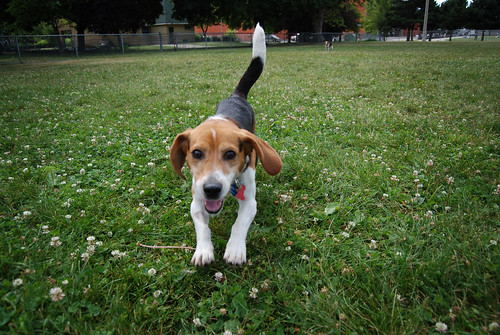
I don't update this blog as much as I used to, mostly because I spend most of my writing efforts on www.whenhoundsfly.com or blog.whenhoundsfly.com, but I thought I would post a quick and brief update on both Duke and Petey.
Update on Duke:
Duke finished his beginner's agility class in the summer. He did fairly well in it but most importantly got calmer and got used to working around dogs again. Unfortunately he did get really snarky on one particular dog in class for which we were quite embarrassed about but fortunately nothing bad happened out of it except for a lot of howling. Duke now has a really, really nice Sit Pretty and Play Bow and did a few jumps, coaxed through tunnels, etc.
A very exciting update in the last month or so is we switched Duke to a raw diet (raw with vegetables, and supplements, not prey model). This topic deserves a full blog post later.
Last brief update is our incorporating Behavior Adjustment Training into Duke's mix has been tremendously beneficial.
Update on Petey:
From February till late May, we had a third Beagle houseguest - Cooper, and what I realized after he left was that Cooper's presence was really stressing Petey out. He didn't do that great on the 4th Karen Pryor Academy workshop and during the spring he had lost focus and drive to work. Back then I was perplexed as to why my super drivey happy to work dog had become easily distracted and uninterested in work. Even Steve Benjamin (my instructor with KPA) noticed that Petey was not his usual motivated self.
Well, a few months after Cooper left, I noticed an improvement in Petey. It wasn't coincidental. His motivation to work, focus, and drive went right back to where it was before.
Moral of the story is... if you want the best from your dog, you need to focus on all aspects of a dog's health. Good diet, sufficient peace and quiet (he did NOT have this with Cooper around), physical exercise, mental stimulation, and good health. Cooper's constant howling and barking, and his usurping of a sleeping spot on the dog couch meant that Petey was always on edge, and therefore unable to focus.
So Petey's back! Here's a little video taken last week of Petey working on Finish. The tappy toes and waggy tail that he is known for is in full effect.
I was recently introduced to Behavior Adjustment Training (BAT) for treating fear/aggression (as well as its sister technique, CAT, or Constructional Aggression Treatment).
Having gotten Duke to a certain level using food and classical counter conditioning/desensitization, I am interested in new techniques that could be faster. Maybe BAT is faster than classical counter conditioning and desensitization. Who knows. I'm going to give it a try with Duke and see how he likes it.
I'm feeding Petey in the above video by hand. My goal is to accomplish the following:
1) Condition Petey to think of me more positively. 2) Condition Petey to think of my hands very positively (kibble's coming out of my hands) 3) Condition Petey to get used to his paws, legs, tail, and bum being touched and to make him feel better about it (as he gets to eat while I do it)
(Duke's in the background behind the babygate watching)
Its been about 6 months since we helped Elmo find his forever home (he's doing well and his new family love him!). We kept a spot open for another foster dog but it had to be the right one. One that was a bit more challenging. Well we found him.
Meet Petey, a lovely 5 year old (estimated) beagle found in the woods in rural Ontario. The shelter was expecting a quick adoption for him since he's a sweety, but unfortunately, when he gets handled roughly (too quick or too strong touches to his hind area) he warning bites. A vet was bit when he was getting poked and prodded, and as a result, the shelter could not adopt him out. If he didn't find a foster home he would have been PTS (put to sleep).
We took him into Foster via Big On Beagles (www.bigonbeagles.ca) and he'll likely be with us for a few months until we've had a chance to work on his behavioral issues. He has no training (he doesn't even know how to sit pretty to beg for food) but in the three days we've had him I can tell you he has tremendous potential - he is a VERY fast learner.
As he's a wild one we're doing all the basics. There are some basic rules of crating I'll share first:
1. Crates are never used as punishment. 2. Use food or toys to get them to go in - don't ever push their behind him. Good examples would be a Kong stuffed with treats and cheese/peanut butter, or his dinner in a bowl. If you are in a pinch and can't wait, you can pick the dog up off his legs and "toss" him in - but this way you aren't turning it into a wrestling match. 3. The dog will likely fuss and fight and bark and howl to get out once he realizes that he's "stuck". In an ideal world, you would slowly build up the amount of time from seconds to minutes so that your dog doesn't get to that point while learning how to be in the crate, but since we're potty training an adult dog, we have no choice but to leave him in there while his bladder fills and he learns to hold it. 4. So you just have to let the dog howl and cry it out. The behavior will extinguish itself when the dog realizes all the fussing in world doesn't get them out. Alternatively, if the dog howls and barks and you cave and let them out, you've basically rewarded that behavior and really set yourself back. 5. During this "cry it out" phase, it would be a good idea to place him in a quiet area without traffic. You could use the basement or garage or a small guest room and close the windows/drapes/etc. to try to make this part bearable. If you left him in the living room while doing this, the comings and goings of family members could be regarded as a reward for his fussing. So he really needs to be isolated for a while to figure this out. 6. When he's ready to be let out, make sure he's totally quiet and relaxed. That way he'll notice that the only time he ever gets let out is in that state of relaxation. 7. If you're potty training, keep the leash near the crate so that when you let him out, you can leash him up and run, don't walk to the yard. The minute he relieves himself, act like you won the lottery and give him a piece of sandwich meat or a liver or other high value treat.
Our first priority is to housetrain and crate train him and this is what we've been doing:
Day 1 (night of arrival) - Brought crate to our bedroom and threw treats in to entice Petey in. He went in and we closed the door. He howled and whined from midnight to 2am and finally we were able to sleep. Friday was a tough day at work.
Day 2 - He was crated all day for 2-3 hour shifts and only let out to pee in the yard (met with lavish praise and treats for appropriate eliminating) and also allowed in the kitchen under close supervision. He marked the sofa once and my messenger bag once by accident but since then no mistakes. When being returned to the crate, we entice with chicken or treats or his food bowl and meal, but he's hesitant to go in. We show him the food and slowly guide his nose into the crate.
Day 3 - More of the same - instead of howling for 2 hours after going in, he's progressively gotten better... first 30 minutes, then he settles, then 20, then 10 - after 10+ repetitions of this crating, he now only howls for 1-2 minutes before settling. This is encouraging since it likely means he will be a quiet crated dog, meaning he could likely be a match for a condos and apartments too.
For now when we crate during the day, we isolate him socially (upstairs) while we work downstairs, but overnight we let him crate in our bedroom. We let him roam under supervision and since the first two accidents, he's not marked, so hopefully we'll have him reliably potty trained very quickly so that we can stop using the crate for potty training (and start playing fun crating games so that he doesn't have a long-term negative association with crating).
You may have read our previous post about Duke's separation anxiety and what we did to manage it. We thought we understood the condition (and by all standard definitions, Duke had it) but it was mild compared to our foster beagle, Elmo's condition.
Firstly if you are reading this to get help for your dog - the first thing you must decide is whether or not your dog truly has separation anxiety. Destructive behavior or barking at home is not enough. A dog that's experiencing true anxiety while left alone will...
1) Pant and hyperventilate 2) Drool 3) Urinate (immediately)
And... getting to more extreme levels
4) Defecate - with loose stool 5) Vomit 6) Eat door mouldings/scratch doors 7) Self-mutilation
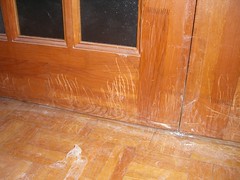
Duke would do items 1, 2, and 3. Elmo does 1 through 6 (Thank goodness he doesn't do #7). He's chewed mouldings off of our doors. He's eaten the mouldings and its come out of his stool. He's scratched at the door. He's had explosive diarrhea in his crate. He's vomited undigested food/bile.
From reading "I'll Be Home Soon" (see our Amazon.com book list for the exact book) and reading many of the online blogs/articles out there, we managed Duke's behavior through crating to keep him out of trouble and using the planned departure method. Elmo's a bit more extreme so we're working on a more intense program. Here's what we're doing.
1) How we use the Crate
Elmo will soil in the crate within minutes if we leave the home. His anxiety overpowers any instinct to keep his den clean. As a result, we use the crate only in these specific ways:
a) He's crated while we're at home in the living room. We're in plain sight of him but through this repetition he'll get used to the confinement aspect of crating while isolating the separation aspect of crating. We will get up and leave and come back intermittently (i.e. getting food from the kitchen, using the bathroom, etc.) Elmo spends far more time with Hyedie and he does with me, and he actually only gets upset when she leaves the room.
b) He sleeps in the crate in the bedroom. In this case his dog bed is in the crate and he goes in there by himself. For now we leave the door open, but we are going to progress to closing him in. Again the objective here is to desensitize him to confinement.
c) In a pinch, if we have to leave home, he goes in the crate --- but unfortunately for now, it is guaranteed that he will pee in the there. At least he doesn't vomit or defecate in there any more. Right now we are renovating our home, so the crate is sometimes the only place he can go. Our preference for Elmo by far is Room Confinement.
2) How we use Room Confinement
We discovered that Elmo did better while confined vs. crated (by accident - we were just trying every possible option to see what worked best). This is what we learned:
a) Elmo, if confined in a room with a closed door, will chew off the moldings and scratch the door. He'll eat the moldings too. Our contractors were amazed that a little 20 pound beagle could do the kind of damage he's done. This is obviously not good (fortunately, everything in our home is going to be replaced as part of our massive renovation) for most home owners with doors and mouldings they are happy with... and the risk of Elmo injuring himself is too great.
b) Elmo, if confined in a room (in this case, our mudroom addition attached to the kitchen) by the use of double stacked baby gates would NOT try to eat his way out of the room. I learned that a closed door becomes a powerful barrier and an object of focus for a panicked dog, while confinement with see-through gates is something entirely different.
c) Comparing Elmo to Duke --- Duke's preference was to be crated. We tried confining Duke in the condo and found that he would soil himself if confined, but hold it if crated. Not sure why, but I guess every dog is different.
3) The Gameplan:
1) We'll be building up Elmo's tolerance to confinement by crating him as often as we can and as for long as we can in ways that keep him from going over the edge (urinating). Over time we'll slowly increase the amount of time that we crate him and slowly increase the distance and duration that we leave him alone while crated.
2) We'll continue to use confinement when we have to leave for a very long time (1 hour or more)
3) We'll employ every tactic in the book (I won't go into detail - just google the topics - there are plenty of articles about each strategy), including:
a) Leaving an article of worn, soiled clothing with Elmo b) Feeding in the crate (always!) c) Leaving frozen peanut butter kongs and other chew toys (he ignores them for now) d) Low key departures e) Ignoring him when we return (for at least a few minutes, and slowly build up) f) Naturopathic / holistic remedies - Rescue Remedy, Star of Bethlehem added to his water g) Under consideration, although we're not acting on it now - DAP Diffusers or possible anti-anxiety medications.
Thanks for reading... hopefully this helps you - it will certainly help us as we track Elmo's progress. He's worth it! Whoever adopts this lovely dog, by the time we're done with him, will have themselves an issue proof dog that is the star of the dog park.
By the way, that's Elmo in the video below. Hyedie's just left the living room so he's whining a bit while I sit here writing this blog post watching TV. We're proud of him! He's made a lot of progress in a very short amount of time.
Our veterinarian and animal communicator believe that dogs are able to read your mind. So, if you are trying to train your beagle or correct your beagle's behavior (ours has a habit of howling at other dogs on the street while on leash), it is very important to have a positive state of mind. If you get into a situation where you think your dog will misbehave, there's a good chance he will!
In our case, when we are walking Duke and see a dog approaching, if we freeze up and get nervous, Duke tends to react. Recently I created a phrase that I say to myself whenever I find myself in that situation - it reads,
"Duke, here's a chance for you to really impress us!"
I find that saying that to myself puts me in a positive state of mind and I am confident that Duke can read our minds!