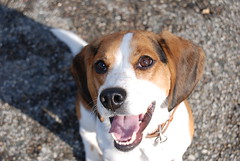
I was recently introduced to Behavior Adjustment Training (BAT) for treating fear/aggression (as well as its sister technique, CAT, or Constructional Aggression Treatment).
Having gotten Duke to a certain level using food and classical counter conditioning/desensitization, I am interested in new techniques that could be faster. Maybe BAT is faster than classical counter conditioning and desensitization. Who knows. I'm going to give it a try with Duke and see how he likes it.
More posts soon!
Showing posts with label aggression. Show all posts
Showing posts with label aggression. Show all posts
Sunday, December 27, 2009

Tuesday, July 21, 2009
Desensitizing your Dog to Paw and Tail Grabbing
I'm feeding Petey in the above video by hand. My goal is to accomplish the following:
1) Condition Petey to think of me more positively.
2) Condition Petey to think of my hands very positively (kibble's coming out of my hands)
3) Condition Petey to get used to his paws, legs, tail, and bum being touched and to make him feel better about it (as he gets to eat while I do it)
(Duke's in the background behind the babygate watching)
Wednesday, January 14, 2009
Review of Feisty Fido by Patricia McConnell, Ph.D. and Karen London, Ph.D

Patricia McConnell needs no introduction. She's the author of the seminal book "The Other End of the Leash" (which I feel should be mandatory reading for every dog owner). I've read dozens of books on dog training and behavior and I've also noticed that the most helpful ones are written by people who have a scientific background and formal education (McConnell has a Ph.D in Zoology and her research focused on interactions between animals and their trainers).
Feisty Fido - Help for the Leash Aggressive Dog, is one of a series of short booklets McConnell's publishing company designed to address very specific behaviorial issues and offer advice in a very succinct and easy to digest manner.
This booklet is designed to help you if your dog is suffering from fear-based aggression while on leash. This book won't be that helpful for other forms of aggression (food/resource guarding, handler aggression, etc.)
What I like most about this booklet is the fact that its written in a way that makes me feel like McConnell and London are talking to me directly. My favorite example is when they describe different training situations in increasing difficulty:
Moderate:
On the sidewalk, as Muffy sees a dog she is friendly with 25 yards away
Difficult:
On the sidewalk, as Muffy sees a dog a third of a block away that she's charged at before
Really Hard:
On a walk when two off leash dogs run up to your dog and try sniffing her while their owner grins from a block away saying "It's Okay! My dogs LOVE other dogs!"
The other strength of this booklet is that it is the best description of a classical counter conditioning program I've ever read. Even a novice dog handler could read this book and do a decent job of implementing the prescribed program.
The only shortcoming of this book is its brevity and where this book ends. By following the program you'll have a dog that is counter conditioned to look at you and avoid pulling towards other dogs while on leash. A side benefit of this program is your dog will heel really nicely too. That's plenty for most and when we got Duke to this level, we were able to enjoy walks again and take Duke all over the place. But if you want to go beyond that and have your dog meet and greet dogs on leash consistently, you'll need to look at Feisty Fido as the first step in a much longer program.
(You can buy the book (and support BayingBeagle.com) from Amazon.ca on the sidebar to the right)
Monday, January 5, 2009
On Leash Aggression with Beagles, Part 2
Just a quick post here. I found this great blog site by the owner of an Italian Greyhound named Peyton. He has made great progress with Peyton and has a video clip showing two very important techniques that we also use for Duke. If we end up getting cornered (dog on the left, right, front, and back) and there's no escape, this is what we do.
The two exercises being demonstrated are the Back Away and Emergency Hold.
Why are these exercises so important? It is very important to set your dog up for success and prevent him from acting inappropriately around other dogs. Each time he lashes out, you are making his problem worse by reinforcing the behavior. Its just like water - over time, water can etch into stone. Each time you put your dog in a situation where he reacts inappropriately, you've etched that behavior deeper into his psyche.
Peyton's blog can be found here for more reading:
http://igtraining.blogspot.com/2007/09/leash-aggression.html
The two exercises being demonstrated are the Back Away and Emergency Hold.
Why are these exercises so important? It is very important to set your dog up for success and prevent him from acting inappropriately around other dogs. Each time he lashes out, you are making his problem worse by reinforcing the behavior. Its just like water - over time, water can etch into stone. Each time you put your dog in a situation where he reacts inappropriately, you've etched that behavior deeper into his psyche.
Peyton's blog can be found here for more reading:
http://igtraining.blogspot.com/2007/09/leash-aggression.html
Tuesday, December 30, 2008
Canine Good Citizen (CGC) Program

One more sleep and two exciting things will be happening:
- 2009 is just around the corner
- Elmo will be going on a trial adoption with a very loving and mature family. (A mom, dad, and 8 year old son)
One of my regrets about fostering Elmo is that I haven't given Duke the attention that he deserves. He's sort of reached a plateau in his training and I'm going to use the new year and Elmo's adoption as a catalyst for reinvigorating my efforts.
My aspiration and goal is to have Duke be able to (or be ready to) earn his Canine Good Citizen certification. (CGC)
What is the CGC? (taken from Wikipedia):
The Canine Good Citizen (CGC) program, established in 1989, is an American Kennel Club program to promote responsible dog ownership and to encourage the training of well-mannered dogs. A dog and handler team must take a short behavioral evaluation of less than half an hour; dogs who pass the evaluation earn the Canine Good Citizen certificate, which many people represent after the dog's name, abbreviating it as CGC; for example, "Fido, CGC".
There are ten objectives that a CGC must pass. I am happy to say Duke could pass 9 of the 10 tomorrow if he had to take the test:
- Accepting a friendly stranger.
- Sitting politely for petting.
- Allowing basic grooming procedures.
- Walking on a loose lead.
- Walking through a crowd.
- Sitting and lying down on command and staying in place.
- Coming when called.
- Reacting appropriately to another dog.
- Reacting appropriately to distractions.
- Calmly enduring supervised separation from the owner.
In 2008, Hyedie and I worked diligently on making Duke practice avoidance around other dogs - that is, his automatic response to seeing a dog while on leash is to look at his handler and move away from the other dog. In 2009, I would like Duke to have the ability to greet another dog, touch him, and move away, all while on leash.
I've ordered a set of reference materials and training guides which I will review and keep everyone up to date on our progress over the next year!
Wednesday, September 12, 2007
Duke's lunging, howling, on-leash aggression (but not to beagles)
I recently found this discussion on MetaFilter while doing some searching and I wanted to share it with everyone:
http://ask.metafilter.com/39796/My-freaky-lunging-barking-beagle
"We adopted our beagle mix, Harvey, from the city shelter about a year ago. He's about 4-5 years old now. He's a great dog, great around strangers, have to watch him a bit around little kids, very easygoing. He is our only pet. We take him on walks in the morning and in the evening, and when we do, we have to always keep an eye out for other dogs because he simply FREAKS OUT when he sees them. Barks, lunges towards them, whines, etc. Most of the time, the other dogs don't respond. We've tried to ignore it, tried to correct him by saying "no," simply try avoiding other dogs by crossing the street or lingering behind cars so he doesn't see them walking. "
Duke has this same problem too. It appeared about 2 months after we adopted him and it REALLY, REALLY started getting silly about 6 months of having him in our family. There were times where at the mere sight of a dog - any dog - even a block away - that Duke would lunge, pull, jump, flip, and howl at the top of his lungs and even pull so hard that it sounded like he was gagging himself.
Our first mistake was not consulting a professional behavioralist sooner. We should have gotten professional, hands-on assistance well before the 6 month mark but instead we surfed web sites, read discussion forums, bought books from Amazon.com (some were good, many we tried and had no results).
We ended up working with Joan Weston who is Who's Walking Who's resident behavioralist (http://www.whoswalkingwho.net/behaviourconsults.html). Here's a summary of the type behavior modification we've been working on since May...
Conditioning Duke to look at us when he sees a dog.
We started using some very high value treats. The first type of food we used was boiled chicken thighs, shredded into manageable chunks for feeding.
Joan took us to a small park across the street full of dogs. We kept our distance from the dogs and we were instructed to feed and praise Duke lavishly every single time Duke looked at us. We also called Duke's name and if he spun around to look at us, we feed and praise. If he does it when a dog is nearby or if he manages to break his gaze from a dog to look at us, he gets TONS of food and praise.
There were times where Duke would not turn to look at us and was just too focused on a distraction (ie. a dog). We can pinch his bum or grab his tail (gently), just to get him to turn around and see what I'm doing. Then he gets praise for doing the turnaround.
Duke is VERY food motivated and this was easy and fun for him to get started with. It was amazing, even on day 1, because we were in a dog park that had upwards of 2 or 3 dogs walking through at any time and Duke was absolutely fixated on chicken and was quick to "check in" with us.
Towards the end of our session as we were leaving the park to return home, we ran into an extremely aggressive/reactive and poorly trained german sheppard in our building which caused both dogs to start barking/lunging uncontrollably. In this sort of situation where Duke's already gone ballistic, we simply turn around and walk away. There's no learning that can happen once he's gone past the point of no return.
Short-Term Results
Just one day of training made our previously frustrating/worrisome task of walking Duke into one that was manageable and increasingly positive and happy!
There were ups and downs though. For what seemed like no reason or logic, there would be walks in the AM that were "happy and howl free", and walks that same evening where he howled at half the dogs we spotted.
Here are some of the things we learned as part of the process:
1) You must believe that your dog will do the right thing!
We noticed that if we saw a dog that was approaching and that we felt Duke would go crazy, sure enough he'd lose it. Perhaps it has to do with a change in breathing, pulse, body temperature, or maybe dogs are psychic - bottom line is you have to believe in your dog!
2) Don't push too hard
Although we had major progress from just the first day of training, it has been really important over the last 4 months to set reasonable expectations and be patient with Duke. He has ups and downs but the overall trend has been extremely positive. Just because he had a good week, doesn't mean it's time to take Duke to a dog parade!
3) Don't train for too long
Duke can only remain focus and check in for 40 minutes or so at a time (about the length of his walk). After that, it's time to let him relax and have a good game of tug or fetch just to relax.
4) Keep the treats interesting
Don't use the same treats every day, change the quantity/portion of treats you give each time - sometimes don't treat at all and just praise. If it becomes a predictable, 1 treat per reward, same treat each time, Duke gets bored.
5) SEEK PROFESSIONAL HELP!
I hope that this blog post helps you if you have the same problem... but if reading books and web sites is not the way to learn how to help your dog if he has leash aggression issues. Please find a behavioralist that uses positive training methods (treats, praise) and get some hands on help.
Longer Term Results (4 months later)
Every single time we walk Duke, we have a treat bag and clicker on hand. We've been walking Duke and praising him for every check in. Over 4 months that's around 360 walks.
Here's a video of Duke we just took...
As a benchmark, Duke now...
- Ignores a lot of dogs and doesn't even care about them.
- Will spot dogs that get him nervous/excited, but will turn around and look at us as the conditioned response.
- Has not gotten into any dog fights at the off leash dog park
- Is much easier to train and heels much better on walks now
- Does sometime still lose control on certain dogs (there are a few in the neighbourhood that we know cause him problems), especially un-neutered, intact dogs.
http://ask.metafilter.com/39796/My-freaky-lunging-barking-beagle
"We adopted our beagle mix, Harvey, from the city shelter about a year ago. He's about 4-5 years old now. He's a great dog, great around strangers, have to watch him a bit around little kids, very easygoing. He is our only pet. We take him on walks in the morning and in the evening, and when we do, we have to always keep an eye out for other dogs because he simply FREAKS OUT when he sees them. Barks, lunges towards them, whines, etc. Most of the time, the other dogs don't respond. We've tried to ignore it, tried to correct him by saying "no," simply try avoiding other dogs by crossing the street or lingering behind cars so he doesn't see them walking. "
Duke has this same problem too. It appeared about 2 months after we adopted him and it REALLY, REALLY started getting silly about 6 months of having him in our family. There were times where at the mere sight of a dog - any dog - even a block away - that Duke would lunge, pull, jump, flip, and howl at the top of his lungs and even pull so hard that it sounded like he was gagging himself.
Our first mistake was not consulting a professional behavioralist sooner. We should have gotten professional, hands-on assistance well before the 6 month mark but instead we surfed web sites, read discussion forums, bought books from Amazon.com (some were good, many we tried and had no results).
We ended up working with Joan Weston who is Who's Walking Who's resident behavioralist (http://www.whoswalkingwho.net/behaviourconsults.html). Here's a summary of the type behavior modification we've been working on since May...
Conditioning Duke to look at us when he sees a dog.
We started using some very high value treats. The first type of food we used was boiled chicken thighs, shredded into manageable chunks for feeding.
Joan took us to a small park across the street full of dogs. We kept our distance from the dogs and we were instructed to feed and praise Duke lavishly every single time Duke looked at us. We also called Duke's name and if he spun around to look at us, we feed and praise. If he does it when a dog is nearby or if he manages to break his gaze from a dog to look at us, he gets TONS of food and praise.
There were times where Duke would not turn to look at us and was just too focused on a distraction (ie. a dog). We can pinch his bum or grab his tail (gently), just to get him to turn around and see what I'm doing. Then he gets praise for doing the turnaround.
Duke is VERY food motivated and this was easy and fun for him to get started with. It was amazing, even on day 1, because we were in a dog park that had upwards of 2 or 3 dogs walking through at any time and Duke was absolutely fixated on chicken and was quick to "check in" with us.
Towards the end of our session as we were leaving the park to return home, we ran into an extremely aggressive/reactive and poorly trained german sheppard in our building which caused both dogs to start barking/lunging uncontrollably. In this sort of situation where Duke's already gone ballistic, we simply turn around and walk away. There's no learning that can happen once he's gone past the point of no return.
Short-Term Results
Just one day of training made our previously frustrating/worrisome task of walking Duke into one that was manageable and increasingly positive and happy!
There were ups and downs though. For what seemed like no reason or logic, there would be walks in the AM that were "happy and howl free", and walks that same evening where he howled at half the dogs we spotted.
Here are some of the things we learned as part of the process:
1) You must believe that your dog will do the right thing!
We noticed that if we saw a dog that was approaching and that we felt Duke would go crazy, sure enough he'd lose it. Perhaps it has to do with a change in breathing, pulse, body temperature, or maybe dogs are psychic - bottom line is you have to believe in your dog!
2) Don't push too hard
Although we had major progress from just the first day of training, it has been really important over the last 4 months to set reasonable expectations and be patient with Duke. He has ups and downs but the overall trend has been extremely positive. Just because he had a good week, doesn't mean it's time to take Duke to a dog parade!
3) Don't train for too long
Duke can only remain focus and check in for 40 minutes or so at a time (about the length of his walk). After that, it's time to let him relax and have a good game of tug or fetch just to relax.
4) Keep the treats interesting
Don't use the same treats every day, change the quantity/portion of treats you give each time - sometimes don't treat at all and just praise. If it becomes a predictable, 1 treat per reward, same treat each time, Duke gets bored.
5) SEEK PROFESSIONAL HELP!
I hope that this blog post helps you if you have the same problem... but if reading books and web sites is not the way to learn how to help your dog if he has leash aggression issues. Please find a behavioralist that uses positive training methods (treats, praise) and get some hands on help.
Longer Term Results (4 months later)
Every single time we walk Duke, we have a treat bag and clicker on hand. We've been walking Duke and praising him for every check in. Over 4 months that's around 360 walks.
Here's a video of Duke we just took...
As a benchmark, Duke now...
- Ignores a lot of dogs and doesn't even care about them.
- Will spot dogs that get him nervous/excited, but will turn around and look at us as the conditioned response.
- Has not gotten into any dog fights at the off leash dog park
- Is much easier to train and heels much better on walks now
- Does sometime still lose control on certain dogs (there are a few in the neighbourhood that we know cause him problems), especially un-neutered, intact dogs.
Subscribe to:
Posts (Atom)