Good news! All About Dogs is having a daytime Monday agility class. Since I am busy teaching classes every weekday night, going to other dog training school classes is nearly impossible. Not anymore!
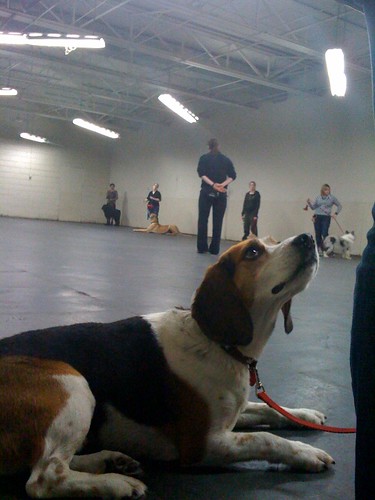
Petey is going back to school next Monday. About a year ago I withdrew him from classes because he was a reactive monster. It will be nice to go back and start fresh again.
Since last year, I have worked considerably on reducing Petey's reactivity towards dogs. In general these are the approaches I have taken:
- Letting Petey meet 100s of dogs so that dogs become "boring". - Reinforcing appropriate dog-dog behavior (butt sniff, crotch sniff) and calming signals (ground sniff, yawn, look away, leave) - Reinforcing "watch me" behavior - Reinforcing passing dogs on the street and maintaining a loose leash by either a) Cueing him to "say hello", or b) Food - Training him at the dog park especially when it's busy - Taking him to his own special "Petey Needs Training" classes at When Hounds Fly (a perk of owning your own dog training school I guess) - Taking him to Pawsway to train.
Recently, I took Petey to a volunteer/rescue event where he even did a little heelwork routine in front of an audience of people and dogs and he did great!
I'm looking forward to finally having fun at All About Dogs.
I don't update this blog as much as I used to, mostly because I spend most of my writing efforts on www.whenhoundsfly.com or blog.whenhoundsfly.com, but I thought I would post a quick and brief update on both Duke and Petey.
Update on Duke:
Duke finished his beginner's agility class in the summer. He did fairly well in it but most importantly got calmer and got used to working around dogs again. Unfortunately he did get really snarky on one particular dog in class for which we were quite embarrassed about but fortunately nothing bad happened out of it except for a lot of howling. Duke now has a really, really nice Sit Pretty and Play Bow and did a few jumps, coaxed through tunnels, etc.
A very exciting update in the last month or so is we switched Duke to a raw diet (raw with vegetables, and supplements, not prey model). This topic deserves a full blog post later.
Last brief update is our incorporating Behavior Adjustment Training into Duke's mix has been tremendously beneficial.
Update on Petey:
From February till late May, we had a third Beagle houseguest - Cooper, and what I realized after he left was that Cooper's presence was really stressing Petey out. He didn't do that great on the 4th Karen Pryor Academy workshop and during the spring he had lost focus and drive to work. Back then I was perplexed as to why my super drivey happy to work dog had become easily distracted and uninterested in work. Even Steve Benjamin (my instructor with KPA) noticed that Petey was not his usual motivated self.
Well, a few months after Cooper left, I noticed an improvement in Petey. It wasn't coincidental. His motivation to work, focus, and drive went right back to where it was before.
Moral of the story is... if you want the best from your dog, you need to focus on all aspects of a dog's health. Good diet, sufficient peace and quiet (he did NOT have this with Cooper around), physical exercise, mental stimulation, and good health. Cooper's constant howling and barking, and his usurping of a sleeping spot on the dog couch meant that Petey was always on edge, and therefore unable to focus.
So Petey's back! Here's a little video taken last week of Petey working on Finish. The tappy toes and waggy tail that he is known for is in full effect.
As mentioned in previous entries, I'm currently working through Control Unleashed by Leslie McDevitt. In it, very early on, she references Dr. Karen Overall's Protocol for Relaxation as a foundation exercise for the work.
Years ago, I stumbled upon it, and at the time (back when I didn't really have a good understanding of classical conditioning), I dismissed it as a series of down-stay exercises of increasing duration and distraction. Now, knowing better, I realize that its an invaluable way to condition a relaxed state in a hyperactive, vigilant, or anxious dog!
So, I started the work tonight with Petey. Petey is an awesome dog to work with, but when we first fostered him, he had NO impulse control. It wouldn't take much stimulation to get him into a frenzy (i.e. if a dog was playing fetch, he'd chase after the other dog and bite them). He's much better now, but with his reactivity at agility class recently, I've decided that Petey's next challenge (and my next training challenge) is to do the work McDevitt prescribes in Control Unleashed and make him my own "Snap" (Leslie's hyper vigilant reactive rescue that became the genesis for her program).
The book itself doesn't actually tell you how to implement the protocol, so I've googled high and low and found the following resources:
A video showing a dog working on the Day 1 exercise. No event marker/clicker. Just feeding in place.
This is the complete document with instructions and the training plan. The problem with the training plan is there are a ton of exercises to be done consecutively and if you don't have the luxury of a friend reading them to you as you do the work, its awkward trying to read a piece of paper.
Courtesy of www.championofmyheart.com - Roxanne Hawn has made audio files of the protocol! Now, you can just put the tracks on your iPod and do the work ANYWHERE!
With these resources, anyone can do the work now on their own. I can't wait to share my findings as we proceed. If any readers have done the work themselves, please comment and let us know what your personal experience has been.
Duke at school nearly 2 years ago. Focused and locked on.
I recently enrolled Petey into a beginner's agility class at All About Dogs, a new training school that opened on the west end of Toronto this year. The head trainer and owner is pure +R and is an accomplished dog sports/agility trainer so I was quite excited to visit their school, observe class, and enroll.
Some of you might recall that when we first took Petey into fostering, we enrolled him at Who's Walking Who so that we could observe how he'd be in a group class setting - he was awesome - a bit interested in other dogs, but extremely handler focused and he worked diligently (earning him the Top Dog award at WWW!). That was the proof I needed that Petey would be great for my Karen Pryor Academy dog, where he worked reliably off leash in class on exercises like paw target the cone, nose target the disc, loose leash walk past the steak, etc.
When I talk to my students at When Hounds Fly about training new behaviors in distraction free environments, I talk about reliable recall and focus at the dog park as being the ultimate test. Petey and Duke recall, target, stay, etc. very well at the dog parks, so I guessed they were ready for class!
To my surprise, both Petey and Duke were extremely distracted and unfocused at agility class, to the point that I would label them as reactive!
Oops, dog trainer error. I never take them to my own classes (since I want to focus on clients) and its been so long since they've been to group classes (Duke hasn't been in school for 2 years), I really let them slide.
Duke will be continuing on in agility class, but I have a lot of focus and attention exercises ahead of me to get him ready - and I'll be blogging about it here.
The shoemaker's children are often shoeless... but not for long! Duke, you're getting a new pair!
I'm feeding Petey in the above video by hand. My goal is to accomplish the following:
1) Condition Petey to think of me more positively. 2) Condition Petey to think of my hands very positively (kibble's coming out of my hands) 3) Condition Petey to get used to his paws, legs, tail, and bum being touched and to make him feel better about it (as he gets to eat while I do it)
(Duke's in the background behind the babygate watching)
Its been about 6 months since we helped Elmo find his forever home (he's doing well and his new family love him!). We kept a spot open for another foster dog but it had to be the right one. One that was a bit more challenging. Well we found him.
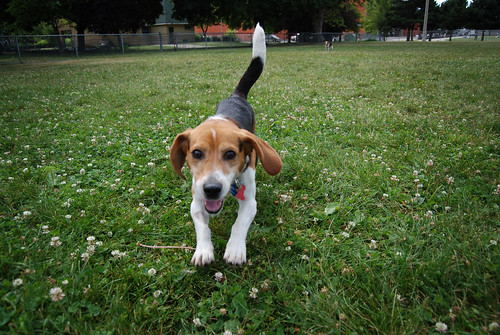
Meet Petey, a lovely 5 year old (estimated) beagle found in the woods in rural Ontario. The shelter was expecting a quick adoption for him since he's a sweety, but unfortunately, when he gets handled roughly (too quick or too strong touches to his hind area) he warning bites. A vet was bit when he was getting poked and prodded, and as a result, the shelter could not adopt him out. If he didn't find a foster home he would have been PTS (put to sleep).
We took him into Foster via Big On Beagles (www.bigonbeagles.ca) and he'll likely be with us for a few months until we've had a chance to work on his behavioral issues. He has no training (he doesn't even know how to sit pretty to beg for food) but in the three days we've had him I can tell you he has tremendous potential - he is a VERY fast learner.
As he's a wild one we're doing all the basics. There are some basic rules of crating I'll share first:
1. Crates are never used as punishment. 2. Use food or toys to get them to go in - don't ever push their behind him. Good examples would be a Kong stuffed with treats and cheese/peanut butter, or his dinner in a bowl. If you are in a pinch and can't wait, you can pick the dog up off his legs and "toss" him in - but this way you aren't turning it into a wrestling match. 3. The dog will likely fuss and fight and bark and howl to get out once he realizes that he's "stuck". In an ideal world, you would slowly build up the amount of time from seconds to minutes so that your dog doesn't get to that point while learning how to be in the crate, but since we're potty training an adult dog, we have no choice but to leave him in there while his bladder fills and he learns to hold it. 4. So you just have to let the dog howl and cry it out. The behavior will extinguish itself when the dog realizes all the fussing in world doesn't get them out. Alternatively, if the dog howls and barks and you cave and let them out, you've basically rewarded that behavior and really set yourself back. 5. During this "cry it out" phase, it would be a good idea to place him in a quiet area without traffic. You could use the basement or garage or a small guest room and close the windows/drapes/etc. to try to make this part bearable. If you left him in the living room while doing this, the comings and goings of family members could be regarded as a reward for his fussing. So he really needs to be isolated for a while to figure this out. 6. When he's ready to be let out, make sure he's totally quiet and relaxed. That way he'll notice that the only time he ever gets let out is in that state of relaxation. 7. If you're potty training, keep the leash near the crate so that when you let him out, you can leash him up and run, don't walk to the yard. The minute he relieves himself, act like you won the lottery and give him a piece of sandwich meat or a liver or other high value treat.
Our first priority is to housetrain and crate train him and this is what we've been doing:
Day 1 (night of arrival) - Brought crate to our bedroom and threw treats in to entice Petey in. He went in and we closed the door. He howled and whined from midnight to 2am and finally we were able to sleep. Friday was a tough day at work.
Day 2 - He was crated all day for 2-3 hour shifts and only let out to pee in the yard (met with lavish praise and treats for appropriate eliminating) and also allowed in the kitchen under close supervision. He marked the sofa once and my messenger bag once by accident but since then no mistakes. When being returned to the crate, we entice with chicken or treats or his food bowl and meal, but he's hesitant to go in. We show him the food and slowly guide his nose into the crate.
Day 3 - More of the same - instead of howling for 2 hours after going in, he's progressively gotten better... first 30 minutes, then he settles, then 20, then 10 - after 10+ repetitions of this crating, he now only howls for 1-2 minutes before settling. This is encouraging since it likely means he will be a quiet crated dog, meaning he could likely be a match for a condos and apartments too.
For now when we crate during the day, we isolate him socially (upstairs) while we work downstairs, but overnight we let him crate in our bedroom. We let him roam under supervision and since the first two accidents, he's not marked, so hopefully we'll have him reliably potty trained very quickly so that we can stop using the crate for potty training (and start playing fun crating games so that he doesn't have a long-term negative association with crating).
Today, Duke was a champ! No incidents of howling in class and he was focused the whole time. A few factors playing into his outstanding performance:
1) He's had bouts of diarrhea in the last few weeks due to a diet switch and eating a lot of melting food from the streets. He's feeling better. Illness or injury plays a huge part in reactivity.
2) We fast him on school nights so he's more motivated to do work. Basically he gets a very small breakfast and that's it all day. This just increases his motivation and drive for food reward.
3) We also put cheddar cheese into the treat bag (thereby increasing the value of the rewards)
We were able to walk by many dogs in class, and have many dogs walk by us, and Duke either held it together or we were able to put him in a backaway.
In today's class we learned:
1) Down stay while reading the newspaper 2) Down stay while getting up to go to the door and come back 3) Down stay while other dogs are recalled (Last year, Duke couldn't do this in Step Ahead - he'd recall to the arms of other dog owners calling COME - this year he nailed it!) 4) Go to your Bed 5) Emergency stay mid-recall (see video)
Patricia McConnell needs no introduction. She's the author of the seminal book "The Other End of the Leash" (which I feel should be mandatory reading for every dog owner). I've read dozens of books on dog training and behavior and I've also noticed that the most helpful ones are written by people who have a scientific background and formal education (McConnell has a Ph.D in Zoology and her research focused on interactions between animals and their trainers).
Feisty Fido - Help for the Leash Aggressive Dog, is one of a series of short booklets McConnell's publishing company designed to address very specific behaviorial issues and offer advice in a very succinct and easy to digest manner.
This booklet is designed to help you if your dog is suffering from fear-based aggression while on leash. This book won't be that helpful for other forms of aggression (food/resource guarding, handler aggression, etc.)
What I like most about this booklet is the fact that its written in a way that makes me feel like McConnell and London are talking to me directly. My favorite example is when they describe different training situations in increasing difficulty:
Moderate: On the sidewalk, as Muffy sees a dog she is friendly with 25 yards away
Difficult: On the sidewalk, as Muffy sees a dog a third of a block away that she's charged at before
Really Hard: On a walk when two off leash dogs run up to your dog and try sniffing her while their owner grins from a block away saying "It's Okay! My dogs LOVE other dogs!"
The other strength of this booklet is that it is the best description of a classical counter conditioning program I've ever read. Even a novice dog handler could read this book and do a decent job of implementing the prescribed program.
The only shortcoming of this book is its brevity and where this book ends. By following the program you'll have a dog that is counter conditioned to look at you and avoid pulling towards other dogs while on leash. A side benefit of this program is your dog will heel really nicely too. That's plenty for most and when we got Duke to this level, we were able to enjoy walks again and take Duke all over the place. But if you want to go beyond that and have your dog meet and greet dogs on leash consistently, you'll need to look at Feisty Fido as the first step in a much longer program.
(You can buy the book (and support BayingBeagle.com) from Amazon.ca on the sidebar to the right)
You may have read our previous post about Duke's separation anxiety and what we did to manage it. We thought we understood the condition (and by all standard definitions, Duke had it) but it was mild compared to our foster beagle, Elmo's condition.
Firstly if you are reading this to get help for your dog - the first thing you must decide is whether or not your dog truly has separation anxiety. Destructive behavior or barking at home is not enough. A dog that's experiencing true anxiety while left alone will...
1) Pant and hyperventilate 2) Drool 3) Urinate (immediately)
And... getting to more extreme levels
4) Defecate - with loose stool 5) Vomit 6) Eat door mouldings/scratch doors 7) Self-mutilation
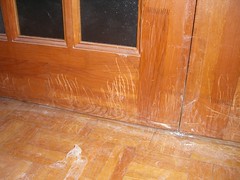
Duke would do items 1, 2, and 3. Elmo does 1 through 6 (Thank goodness he doesn't do #7). He's chewed mouldings off of our doors. He's eaten the mouldings and its come out of his stool. He's scratched at the door. He's had explosive diarrhea in his crate. He's vomited undigested food/bile.
From reading "I'll Be Home Soon" (see our Amazon.com book list for the exact book) and reading many of the online blogs/articles out there, we managed Duke's behavior through crating to keep him out of trouble and using the planned departure method. Elmo's a bit more extreme so we're working on a more intense program. Here's what we're doing.
1) How we use the Crate
Elmo will soil in the crate within minutes if we leave the home. His anxiety overpowers any instinct to keep his den clean. As a result, we use the crate only in these specific ways:
a) He's crated while we're at home in the living room. We're in plain sight of him but through this repetition he'll get used to the confinement aspect of crating while isolating the separation aspect of crating. We will get up and leave and come back intermittently (i.e. getting food from the kitchen, using the bathroom, etc.) Elmo spends far more time with Hyedie and he does with me, and he actually only gets upset when she leaves the room.
b) He sleeps in the crate in the bedroom. In this case his dog bed is in the crate and he goes in there by himself. For now we leave the door open, but we are going to progress to closing him in. Again the objective here is to desensitize him to confinement.
c) In a pinch, if we have to leave home, he goes in the crate --- but unfortunately for now, it is guaranteed that he will pee in the there. At least he doesn't vomit or defecate in there any more. Right now we are renovating our home, so the crate is sometimes the only place he can go. Our preference for Elmo by far is Room Confinement.
2) How we use Room Confinement
We discovered that Elmo did better while confined vs. crated (by accident - we were just trying every possible option to see what worked best). This is what we learned:
a) Elmo, if confined in a room with a closed door, will chew off the moldings and scratch the door. He'll eat the moldings too. Our contractors were amazed that a little 20 pound beagle could do the kind of damage he's done. This is obviously not good (fortunately, everything in our home is going to be replaced as part of our massive renovation) for most home owners with doors and mouldings they are happy with... and the risk of Elmo injuring himself is too great.
b) Elmo, if confined in a room (in this case, our mudroom addition attached to the kitchen) by the use of double stacked baby gates would NOT try to eat his way out of the room. I learned that a closed door becomes a powerful barrier and an object of focus for a panicked dog, while confinement with see-through gates is something entirely different.
c) Comparing Elmo to Duke --- Duke's preference was to be crated. We tried confining Duke in the condo and found that he would soil himself if confined, but hold it if crated. Not sure why, but I guess every dog is different.
3) The Gameplan:
1) We'll be building up Elmo's tolerance to confinement by crating him as often as we can and as for long as we can in ways that keep him from going over the edge (urinating). Over time we'll slowly increase the amount of time that we crate him and slowly increase the distance and duration that we leave him alone while crated.
2) We'll continue to use confinement when we have to leave for a very long time (1 hour or more)
3) We'll employ every tactic in the book (I won't go into detail - just google the topics - there are plenty of articles about each strategy), including:
a) Leaving an article of worn, soiled clothing with Elmo b) Feeding in the crate (always!) c) Leaving frozen peanut butter kongs and other chew toys (he ignores them for now) d) Low key departures e) Ignoring him when we return (for at least a few minutes, and slowly build up) f) Naturopathic / holistic remedies - Rescue Remedy, Star of Bethlehem added to his water g) Under consideration, although we're not acting on it now - DAP Diffusers or possible anti-anxiety medications.
Thanks for reading... hopefully this helps you - it will certainly help us as we track Elmo's progress. He's worth it! Whoever adopts this lovely dog, by the time we're done with him, will have themselves an issue proof dog that is the star of the dog park.
By the way, that's Elmo in the video below. Hyedie's just left the living room so he's whining a bit while I sit here writing this blog post watching TV. We're proud of him! He's made a lot of progress in a very short amount of time.
***Dec 2010 Update --- we abandoned home cooked meals about 6 months into it because either directly or indirectly his urine developed a weird PH level and he started having pee dribbles. I suspect it had to do with our homecooked meal that was FAR from properly balanced. Since then we went to different commercial foods finally settling on hiring a proper canine nutritionist to make a raw food diet plan just for us. There are upwards of 8 different ingredients and 10 supplements used to make it balanced. Moral of the story: Don't just wing it like we did back then.****
Its been about 1.5 months since the change from kibble to natural food. I ordered a great book that has a ton of recipes that are easy to follow. The book also lists foods that are dangerous for dogs (ie. onions, chocolate, etc.) and also has a section on calcium supplements.
I hypothesized that Duke's improved behavior may have been because of the food, but I'm convinced that its an absolute fact. In fact, the author of Natural Dog Food clearly states that a change in diet can fix behavioral issues.
Its worth noting that cooking for your dog doesn't mean cooking every day. We typically prepare batches of food and freeze it and serve throughout the week.
If you think about it, its worth it - after all - if kibble can sit in the open for months and not get moldy, it means that its either loaded with preservatives or it lacks nutrients to the point that bacteria can't even thrive off it.
I recently stumbled (somewhat randomly, by reading Amazon.com book reviews) upon a lesser-known dog training author named Kevin Behan who wrote the book Natural Dog Training back in 2001. I recently bought and read the book and want to share this with everyone.
So, just as a bit of background, we are strong proponents of positive training methods. The behaviorist who helped us turn Duke around got us focused on classical counter-conditioning and positive training methods such as treat-based rewards. It's worked really well.
The great thing about learning about Natural Dog Training is that as a philosophy or approach to dog training, it doesn't directly contradict positive method or clicker training whatsoever. The approach can actually strengthen and improve your results (it has for us!).
The basic tenant of Natural Dog Training is that all dogs have an innate desire to make prey, chase prey, and bite. In the wild, dogs work in groups to hunt down animals that are much larger and stronger than they are - dogs are most satisfied and content as they work together and ultimately get to sink their teeth into the moose or deer or whatever they're going after.
Duke used to have that opportunity as he was actually a working hunting beagle. Now that he's a family dog living in the city, he doesn't have the opportunity anymore. Natural dog training is all about providing healthy, appropriate avenues for dogs to exercise that need to hunt and bite prey. Examples might be:
- Playing fetch with their owner (and returning the ball!) - Playing tug with their owner (and winning) - Playing hide and seek with their owner - Practicing long sit or down-stays followed with enthusiastic come/chases with their owner - Playing "push" with their owner (this is a game best explained through another resource I'll reference later on)
The key here is "with their owner". By offering and engaging activities like fetch, tug of war, hide and seek, "push", and sit/stay games, and rewarding Duke with praise, food, and an object to bite (in our case, a squeeky toy), we've strengthened our relationship with Duke in just a couple of weeks. The most noticeable change is Duke's recall! In the past, we had almost zero recall. The only way to pull him back towards us was to bribe him with a squeeky toy. Now, just calling him gets him to run towards us with full enthusiasm!
In contrast, how many times have you seen a dog owner try to get their dog to recall, only to switch to an angry sounding voice, get frustrated, and then start to chase after their dog to try to grab them and go home? The dog's natural instinct is to run away from the owner. The opposite is to teach your dog that you are in fact, the most interesting thing in the world to chase:
(our friend Chuck instinctively being the most interesting thing at the park!)
As a book, Natural Dog Training has a few shortcomings. Firstly, it's editing is weak and there are grammatical/spelling errors that I do overlook. Secondly, in some places, its wordy and difficult to follow. Thirdly, Behan advocates both positive (treat based rewards) as well as negative punishment (choke/prong collars). Lastly, and related to the third shortcoming - the ideal audience for this book is someone who has had a fair amount of hands on obedience training experience (ie. you're already somewhat competent at dog training) - for the uninitiated, the instructions would be difficult to visualize and execute. On that note, Behan advocates the use of a pinch collar to refocus a dog - too many ignorant dog owners abuse those training tools - the margin for error is too large, especially without hands on expert supervision.
Want to give it a shot? There are four fun games you can start incorporating into your daily outings with your dog. Check out www.naturaldogblog.com by Neil Sattin. Here are the specific articles that describe the fun games you can play starting tomorrow!
Recently, Duke chewed up his Ikea dog bed and we weren't able to repair or replace it in time. Last night we had him sleep on a towel instead of his regular dog bed and he ended up waking up once every hour all through the night.
Tonight after coming home from work, I had a very bad walking experience with Duke. He was highly distracted (or focused on sniffing snow and grass) and non responsive to my voice. He was extremely dog reactive and howled ballastically at everything.
When I was coming home, I was trying to figure out what it was. Lack of exercise? Change in environment? (It recently snowed 30cm, which has changed the landscape of our neighborhood quite a bit) Something to do with snow? (It was last year when it started snowing that Duke's on-leash aggression became its worst).
Hyedie suggested that the lack of sleep could be a huge reason for his sensitivity today. Last year, Duke had kennel cough when I was away on a business trip and because of this, both of them were up all night as Duke would wake himself up frequently as he coughed and gagged. The next day, he was impossible to walk.
So for now we are going to make sure he gets solid shuteye every night!
Our veterinarian and animal communicator believe that dogs are able to read your mind. So, if you are trying to train your beagle or correct your beagle's behavior (ours has a habit of howling at other dogs on the street while on leash), it is very important to have a positive state of mind. If you get into a situation where you think your dog will misbehave, there's a good chance he will!
In our case, when we are walking Duke and see a dog approaching, if we freeze up and get nervous, Duke tends to react. Recently I created a phrase that I say to myself whenever I find myself in that situation - it reads,
"Duke, here's a chance for you to really impress us!"
I find that saying that to myself puts me in a positive state of mind and I am confident that Duke can read our minds!