Monday, December 24, 2007

Natural Dog Training techniques

I recently stumbled (somewhat randomly, by reading Amazon.com book reviews) upon a lesser-known dog training author named Kevin Behan who wrote the book Natural Dog Training back in 2001. I recently bought and read the book and want to share this with everyone.

So, just as a bit of background, we are strong proponents of positive training methods. The behaviorist who helped us turn Duke around got us focused on classical counter-conditioning and positive training methods such as treat-based rewards. It's worked really well.

The great thing about learning about Natural Dog Training is that as a philosophy or approach to dog training, it doesn't directly contradict positive method or clicker training whatsoever. The approach can actually strengthen and improve your results (it has for us!).

The basic tenant of Natural Dog Training is that all dogs have an innate desire to make prey, chase prey, and bite. In the wild, dogs work in groups to hunt down animals that are much larger and stronger than they are - dogs are most satisfied and content as they work together and ultimately get to sink their teeth into the moose or deer or whatever they're going after.

Duke used to have that opportunity as he was actually a working hunting beagle. Now that he's a family dog living in the city, he doesn't have the opportunity anymore. Natural dog training is all about providing healthy, appropriate avenues for dogs to exercise that need to hunt and bite prey. Examples might be:

- Playing fetch with their owner (and returning the ball!)
- Playing tug with their owner (and winning)
- Playing hide and seek with their owner
- Practicing long sit or down-stays followed with enthusiastic come/chases with their owner
- Playing "push" with their owner (this is a game best explained through another resource I'll reference later on)

The key here is "with their owner". By offering and engaging activities like fetch, tug of war, hide and seek, "push", and sit/stay games, and rewarding Duke with praise, food, and an object to bite (in our case, a squeeky toy), we've strengthened our relationship with Duke in just a couple of weeks. The most noticeable change is Duke's recall! In the past, we had almost zero recall. The only way to pull him back towards us was to bribe him with a squeeky toy. Now, just calling him gets him to run towards us with full enthusiasm!

In contrast, how many times have you seen a dog owner try to get their dog to recall, only to switch to an angry sounding voice, get frustrated, and then start to chase after their dog to try to grab them and go home? The dog's natural instinct is to run away from the owner. The opposite is to teach your dog that you are in fact, the most interesting thing in the world to chase:


(our friend Chuck instinctively being the most interesting thing at the park!)

As a book, Natural Dog Training has a few shortcomings. Firstly, it's editing is weak and there are grammatical/spelling errors that I do overlook. Secondly, in some places, its wordy and difficult to follow. Thirdly, Behan advocates both positive (treat based rewards) as well as negative punishment (choke/prong collars). Lastly, and related to the third shortcoming - the ideal audience for this book is someone who has had a fair amount of hands on obedience training experience (ie. you're already somewhat competent at dog training) - for the uninitiated, the instructions would be difficult to visualize and execute. On that note, Behan advocates the use of a pinch collar to refocus a dog - too many ignorant dog owners abuse those training tools - the margin for error is too large, especially without hands on expert supervision.

Want to give it a shot? There are four fun games you can start incorporating into your daily outings with your dog. Check out www.naturaldogblog.com by Neil Sattin. Here are the specific articles that describe the fun games you can play starting tomorrow!

Tug of war

Push

Hide and Seek (the most amazing way to train your dog to recall)

Fetch

Tuesday, December 18, 2007

Exercise, Diet, Mental Stimulation, and Rest

Recently, Duke chewed up his Ikea dog bed and we weren't able to repair or replace it in time. Last night we had him sleep on a towel instead of his regular dog bed and he ended up waking up once every hour all through the night.

Tonight after coming home from work, I had a very bad walking experience with Duke. He was highly distracted (or focused on sniffing snow and grass) and non responsive to my voice. He was extremely dog reactive and howled ballastically at everything.

When I was coming home, I was trying to figure out what it was. Lack of exercise? Change in environment? (It recently snowed 30cm, which has changed the landscape of our neighborhood quite a bit) Something to do with snow? (It was last year when it started snowing that Duke's on-leash aggression became its worst).

Hyedie suggested that the lack of sleep could be a huge reason for his sensitivity today. Last year, Duke had kennel cough when I was away on a business trip and because of this, both of them were up all night as Duke would wake himself up frequently as he coughed and gagged. The next day, he was impossible to walk.

So for now we are going to make sure he gets solid shuteye every night!

Saturday, December 15, 2007

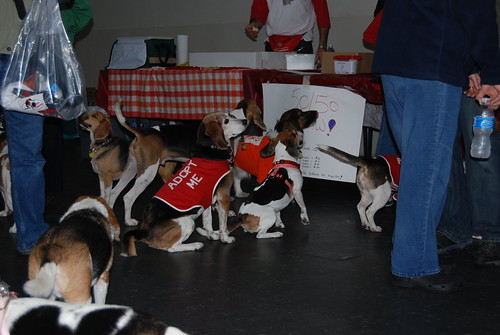
Duke at Big on Beagles 2007 Fundraiser

It's a little late, but I wanted to share some photos and a video of the 2nd Annual Big on Beagle's Bash for Cash fundraiser that we attended.


Duke is always most comfortable around other Beagles. He never shows any leash aggression when we meet new Beagles on the street and always finds a playmate at Big on Beagle's events! Take a look at Duke showing his signature spin move:


We can't wait for the next Big on Beagle's event so we can show our support again. And I'm sure Duke can't wait to have a howling good time and meet up with his friends again!

Monday, October 22, 2007

Xsara from Slovenia

Here's an amazing Beagle named Xsara who has been trained using only positive methods.


Here's her owner's tips on how she did it:

"If using clicker, first teach her that click is always followed by a reward (in my case food). Start clicking every time she looks at you. You want her to pay attention and think that you are really fun. Never work more than 15 minutes together - beagles get bored. Stop playing when it's most fun and she will always want more. Never play until she gets bored! Plan every step of teaching a trick but make every step easy enough for the dog so that she will feel very smart and confident!"

I've bolded some of the most interesting bits. Sometimes we train Duke for too long and he ends up getting bored and giving up. A good example would be having him check in/watch us too much. He stops listening after a while...


Thursday, October 11, 2007

"Step Ahead" Level 2 Obedience Class - Class #6

Oopsies Duke was supposed to sit/stay until I turn around and tell him to go down from a distance - this video is Andre and my favourite! This is a scene from the last class of 'Step Ahead' recorded by Duke's classmate, Photon's Dad. In round two of the game, Photon and Phoebe won, going down right after their mom's said the command - amazing!

It was a fun games night that included sit-stay-musical chairs, Sparky Says (like Simon Says)and the game above in the video 'Bang'. We played several more games, but I can't remember what they were!

It was a really fun night!

Wednesday, September 19, 2007

Lessons from "Step Ahead" Level 2 Obedience Class - Class #5


Second last class last week, before today's fun games night. Last class Andre took the reigns and trained with Duke.

Reviewed:
  • down at a distance (remember to reward in the 'down' position

  • doggy push-ups (then progressed to push-ups with dog to the left)

  • stand stay (then progressed with instructor coming by to distract the dogs by walking by, bouncing a ball and something totally irresistible to Duke, a squeeky toy)

A new exercise that Duke failed at was doing 'sit/stays' with having every other dog stay, while the other dogs completed their 'come' command. Unfortunately Duke released from his stay every time the other handlers called 'come' to their dogs, even though it wasn't Duke's turn to 'come'. Amazingly half the dogs were able to maintain their stays even though dogs next to them ran towards their owners.

Next the owners and dogs did a heeling exercise where 'watch', 'touch', 'down', 'turns' and 'stand' were commanded while walking.

The last exercise of the night was Rally Obedience. Where 2 sets of 3 pylons were set up with 2-3 commands. For example: Sit-down-walk around, Sit-stand, sit-down. The object is to go to each pylon station and try to get your dog to complete the set of commands as fast as possible.

Rally Obedience is apparently an up and coming dog sport. Treats as rewards can be used during competition but treats can not be used as lures.

Again tonight, Duke's attention and concentration levels weren't great and he was easily distracted.

After this course, it's time to work on everything we've learned so that he can do them as fast as he can sit or go down.

Wednesday, September 12, 2007

Duke's lunging, howling, on-leash aggression (but not to beagles)

I recently found this discussion on MetaFilter while doing some searching and I wanted to share it with everyone:
http://ask.metafilter.com/39796/My-freaky-lunging-barking-beagle


"We adopted our beagle mix, Harvey, from the city shelter about a year ago. He's about 4-5 years old now. He's a great dog, great around strangers, have to watch him a bit around little kids, very easygoing. He is our only pet. We take him on walks in the morning and in the evening, and when we do, we have to always keep an eye out for other dogs because he simply FREAKS OUT when he sees them. Barks, lunges towards them, whines, etc. Most of the time, the other dogs don't respond. We've tried to ignore it, tried to correct him by saying "no," simply try avoiding other dogs by crossing the street or lingering behind cars so he doesn't see them walking. "

Duke has this same problem too. It appeared about 2 months after we adopted him and it REALLY, REALLY started getting silly about 6 months of having him in our family. There were times where at the mere sight of a dog - any dog - even a block away - that Duke would lunge, pull, jump, flip, and howl at the top of his lungs and even pull so hard that it sounded like he was gagging himself.

Our first mistake was not consulting a professional behavioralist sooner. We should have gotten professional, hands-on assistance well before the 6 month mark but instead we surfed web sites, read discussion forums, bought books from Amazon.com (some were good, many we tried and had no results).

We ended up working with Joan Weston who is Who's Walking Who's resident behavioralist (http://www.whoswalkingwho.net/behaviourconsults.html). Here's a summary of the type behavior modification we've been working on since May...

Conditioning Duke to look at us when he sees a dog.

We started using some very high value treats. The first type of food we used was boiled chicken thighs, shredded into manageable chunks for feeding.

Joan took us to a small park across the street full of dogs. We kept our distance from the dogs and we were instructed to feed and praise Duke lavishly every single time Duke looked at us. We also called Duke's name and if he spun around to look at us, we feed and praise. If he does it when a dog is nearby or if he manages to break his gaze from a dog to look at us, he gets TONS of food and praise.

There were times where Duke would not turn to look at us and was just too focused on a distraction (ie. a dog). We can pinch his bum or grab his tail (gently), just to get him to turn around and see what I'm doing. Then he gets praise for doing the turnaround.

Duke is VERY food motivated and this was easy and fun for him to get started with. It was amazing, even on day 1, because we were in a dog park that had upwards of 2 or 3 dogs walking through at any time and Duke was absolutely fixated on chicken and was quick to "check in" with us.

Towards the end of our session as we were leaving the park to return home, we ran into an extremely aggressive/reactive and poorly trained german sheppard in our building which caused both dogs to start barking/lunging uncontrollably. In this sort of situation where Duke's already gone ballistic, we simply turn around and walk away. There's no learning that can happen once he's gone past the point of no return.

Short-Term Results

Just one day of training made our previously frustrating/worrisome task of walking Duke into one that was manageable and increasingly positive and happy!

There were ups and downs though. For what seemed like no reason or logic, there would be walks in the AM that were "happy and howl free", and walks that same evening where he howled at half the dogs we spotted.

Here are some of the things we learned as part of the process:

1) You must believe that your dog will do the right thing!

We noticed that if we saw a dog that was approaching and that we felt Duke would go crazy, sure enough he'd lose it. Perhaps it has to do with a change in breathing, pulse, body temperature, or maybe dogs are psychic - bottom line is you have to believe in your dog!

2) Don't push too hard

Although we had major progress from just the first day of training, it has been really important over the last 4 months to set reasonable expectations and be patient with Duke. He has ups and downs but the overall trend has been extremely positive. Just because he had a good week, doesn't mean it's time to take Duke to a dog parade!

3) Don't train for too long

Duke can only remain focus and check in for 40 minutes or so at a time (about the length of his walk). After that, it's time to let him relax and have a good game of tug or fetch just to relax.

4) Keep the treats interesting

Don't use the same treats every day, change the quantity/portion of treats you give each time - sometimes don't treat at all and just praise. If it becomes a predictable, 1 treat per reward, same treat each time, Duke gets bored.

5) SEEK PROFESSIONAL HELP!

I hope that this blog post helps you if you have the same problem... but if reading books and web sites is not the way to learn how to help your dog if he has leash aggression issues. Please find a behavioralist that uses positive training methods (treats, praise) and get some hands on help.

Longer Term Results (4 months later)

Every single time we walk Duke, we have a treat bag and clicker on hand. We've been walking Duke and praising him for every check in. Over 4 months that's around 360 walks.

Here's a video of Duke we just took...


As a benchmark, Duke now...

- Ignores a lot of dogs and doesn't even care about them.
- Will spot dogs that get him nervous/excited, but will turn around and look at us as the conditioned response.
- Has not gotten into any dog fights at the off leash dog park
- Is much easier to train and heels much better on walks now
- Does sometime still lose control on certain dogs (there are a few in the neighbourhood that we know cause him problems), especially un-neutered, intact dogs.